ARIES v2.0 Development Board | THEJAS32 VEGA RISC-V Microprocessor | IoT & Embedded Platform
Description
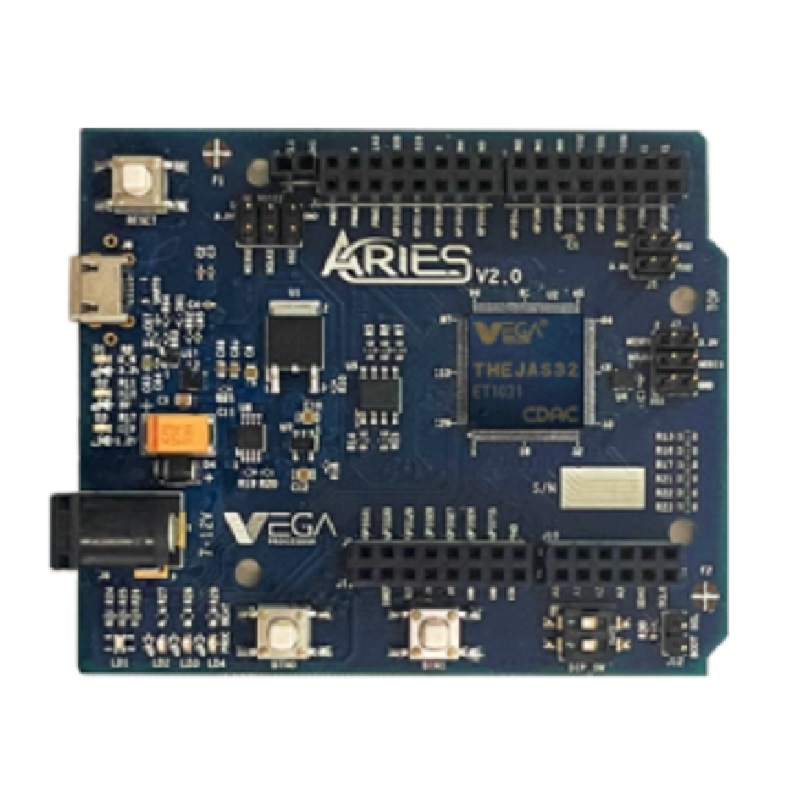
The (SPIDER Automation) ARIES v2.0 Development Board is a robust, feature-rich hardware platform designed around the custom THEJAS32 System-on-Chip (SoC). Developed by the Centre for Development of Advanced Computing (C-DAC) as part of the Digital India RISC-V (DIR-V) Program funded by MeitY, Government of India, this board brings indigenous open-source processor technology directly to developers, engineers, and educational institutions.
At its heart lies the VEGA ET1031 32-bit RISC-V microprocessor running at a stable frequency of 100 MHz. The board comes well-equipped with 256KB of internal SRAM and 2MB of flash memory, providing ample workspace for firmware and real-time processing tasks. Featuring rich connectivity options—including multiple UART, SPI, I2C, and PWM interfaces alongside 32 programmable GPIOs—ARIES v2.0 is engineered to handle diverse workloads ranging from low-power IoT devices and smart meters to sensor fusion networks and industrial systems.
Key Features
- THEJAS32 SoC Core: Powered by C-DAC’s VEGA ET1031 RISC-V microprocessor operating at 100 MHz.
- Generous Memory Layout: Includes 256KB of internal SRAM and 2MB of onboard flash memory for code storage.
- Comprehensive Communication Interfaces: Outfitted with 3 UARTs, up to 4 SPI channels, and 3 I2C interfaces.
- Precision Motor & Power Control: Features 8 dedicated PWM pins and 32 flexible GPIO lines (12 mA DC current per pin).
- Standalone Operation Ready: Equipped with onboard power regulation supporting USB connection or external DC/battery inputs.
- DIR-V Initiative Hardware: Backed by the Indian government’s mission to foster indigenous processor design and education.
Benefits
- Open-Source RISC-V Architecture: Engage with modern, vendor-independent instruction set designs for secure and customized projects.
- Versatile Embedded Integration: Easily interface with diverse sensors, actuators, and communication modules using standard peripheral buses.
- Reliable Low-Power Operation: Optimized for energy-efficient edge applications, battery-operated nodes, and remote sensor deployments.
- Educational & Industrial Utility: Perfect platform for transitioning legacy 8/16-bit applications to contemporary 32-bit RISC-V frameworks.
- Robust Form Factor: Sturdy layout designed for stable benchtop prototyping and integration into electronic enclosures.
- Out-of-the-Box Development: Simple USB connection enables immediate programming and debugging power.
Applications
- Low-Power IoT Nodes: Wireless sensor networks and smart environmental data loggers.
- Smart Metering Infrastructure: Automated utility metering and power consumption monitoring systems.
- Sensor Fusion Projects: Combining data streams from multiple industrial and environmental sensors.
- Industrial Networking & Automation: System supervisors and factory floor monitoring hardware.
- STEM & Electronic Education: Teaching advanced microarchitecture and RISC-V programming in technical institutions.
- Wearable Devices & Remote Gadgets: Compact battery-powered electronic systems and educational hobbyist kits.
Package Includes
- 1 x ARIES v2.0 Development Board
Technical Specifications
| Parameter | Specification |
|---|---|
| Item Type | RISC-V Development Board |
| Brand | SPIDER Automation |
| Model Series | ARIES v2.0 |
| Controller / SoC | THEJAS32 (VEGA ET1031 Microprocessor) |
| Processor Architecture | 32-bit RISC-V |
| Clock Speed | 100 MHz |
| Internal SRAM | 256 KB |
| Flash Memory | 2 MB |
| Operating / I/O Voltage | 3.3 V DC |
| Digital GPIOs | 32 Pins (12 mA DC Current per I/O Pin) |
| Communication Interfaces | 3 × UART, 4 × SPI, 3 × I2C |
| PWM Channels | 8 Pins |
| Board Dimensions (L × W) | 78 mm × 66 mm |
| Gross Shipping Weight | 0.044 kg |
| Package Shipping Dimensions | 8.5 cm × 7.5 cm × 2.5 cm |