
SPIDER Automation Adafruit QT Py SAMD21 Development Board | ATSAMD21E18 & STEMMA QT I2C | For Compact Embedded & Sensor Applications
Description
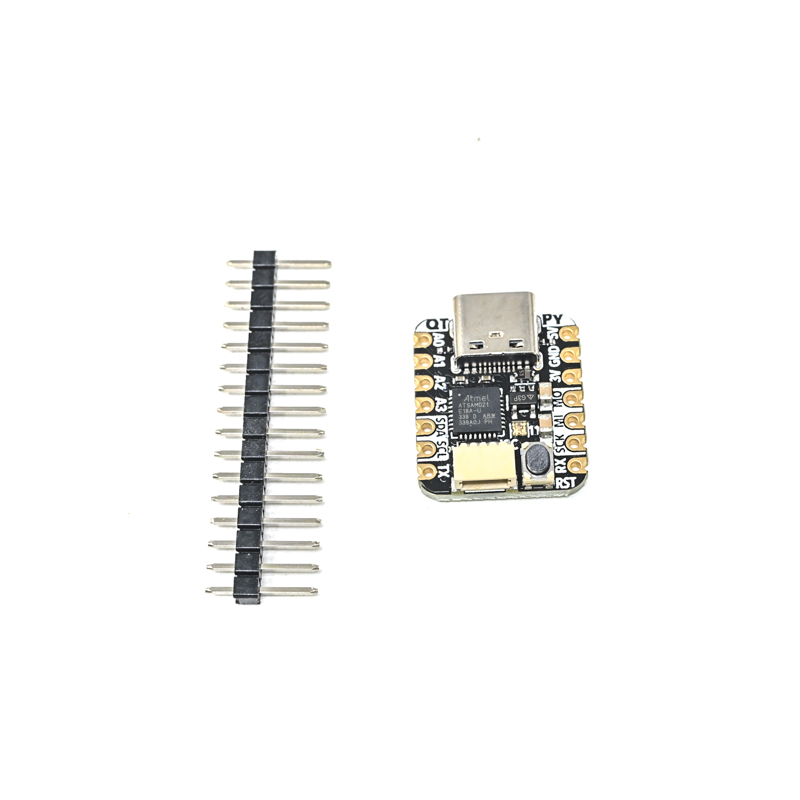
The Adafruit QT Py SAMD21 is a compact microcontroller development board designed for space-constrained embedded systems, sensor interfaces and rapid hardware development. It is powered by the ATSAMD21E18 32-bit Cortex-M0+ microcontroller running at 48MHz, with 256KB internal Flash and 32KB RAM.
A key feature of the QT Py is its integrated STEMMA QT I2C connectivity. The chainable connector system allows compatible sensors and accessories to be connected using plug-and-play cables without requiring additional soldering. The STEMMA QT interface is compatible with the SparkFun Qwiic-style connector ecosystem for I2C peripherals.
The board provides 11 GPIO pins with extensive peripheral capabilities, including 9 × 12-bit analog inputs, a 10-bit analog output, up to 9 PWM outputs, hardware UART, SPI, I2C and I2S. Six capacitive-touch inputs are also available without requiring additional external components.
For development and integration, the QT Py features a USB Type-C connector with native USB support. It can be programmed using the Arduino IDE or CircuitPython and can function as a USB serial device, MIDI device, HID keyboard/mouse or USB storage-style device depending on the firmware implementation.
The compact board includes an RGB NeoPixel with controllable power, allowing visual status indication while providing the option to disable the LED power when low-power operation is required. Castellated pads and the Seeed Xiao-compatible size and pinout make the board suitable for direct PCB mounting and embedded product designs.
An optional SOIC-8 SPI Flash footprint is available on the underside of the board for applications requiring additional storage for data logging or file-based applications.
Key Features
- ATSAMD21E18 Processor: 32-bit ARM Cortex-M0+ microcontroller operating at 48MHz.
- 256KB Internal Flash: Provides program memory for firmware and embedded applications.
- 32KB RAM: Provides runtime memory for application data and processing.
- 11 GPIO Pins: Compact I/O interface with multiple configurable peripheral functions.
- 12-bit Analog Inputs: Nine analog-capable inputs for sensor and measurement applications.
- 10-bit Analog Output: True analog output available on one I/O pin.
- 9 PWM Outputs: PWM capability for LED, actuator and control applications.
- STEMMA QT I2C: Plug-and-play connector for compatible I2C sensors and accessories.
- Chainable I2C Design: Supports convenient connection of compatible STEMMA QT/Qwiic-style peripherals.
- Hardware UART: Serial communication interface for compatible peripherals.
- Hardware SPI: High-speed synchronous interface for compatible devices and peripherals.
- Hardware I2S: Digital audio and streaming interface capability.
- Capacitive Touch: Six capacitive-touch inputs without additional components.
- USB Type-C: Modern connector for power, programming and native USB functions.
- Native USB: Supports USB serial, MIDI, HID and storage-style applications through firmware.
- RGB NeoPixel: Integrated programmable RGB indicator with controllable power.
- 3.3V Regulator: Onboard regulator with up to 600mA peak output.
- Optional SPI Flash: SOIC-8 footprint allows additional SPI Flash to be installed.
- Arduino Compatible: Supports development through the Arduino IDE.
- CircuitPython Compatible: Supports Python-based embedded development.
- Castellated Pads: Suitable for flat PCB mounting and embedded integration.
- Xiao-Compatible Format: Compact physical form factor and pinout compatible with the Seeed Xiao format.
- Reset Button: Allows firmware reset and bootloader access.
Benefits
- Space-Efficient Design: The compact board format is suitable for embedded products where PCB area is limited.
- Solderless Sensor Expansion: STEMMA QT simplifies connection of compatible I2C sensors and accessories.
- Flexible I/O: Analog, PWM, UART, SPI, I2C, I2S and capacitive-touch capabilities support a broad range of peripherals.
- Easy Firmware Development: Arduino IDE and CircuitPython provide flexible development workflows.
- PCB Integration: Castellated pads allow the board to be mounted directly onto a carrier PCB.
- Expandable Storage: The optional SPI Flash footprint allows additional storage for data logging and file-based applications.
Applications
- Sensor Interfaces: Compact systems using I2C, analog and digital sensors.
- IoT Devices: Small embedded controllers and connected sensor platforms when paired with suitable communication hardware.
- Embedded Control: Compact control systems using GPIO, PWM and serial interfaces.
- Data Acquisition: Sensor measurement systems using the onboard analog inputs.
- LED Control: RGB LED and PWM-based lighting or status-control applications.
- Human-Machine Interfaces: Applications using capacitive-touch inputs and visual status indication.
- Audio Interfaces: Embedded systems using I2S and analog output capabilities.
- Compact Robotics: Small controllers for sensors, actuators and peripheral modules.
- PCB-Embedded Controllers: Products requiring a small pre-programmable microcontroller module.
- Rapid Prototyping: Fast development using STEMMA QT accessories, Arduino or CircuitPython.
Package Includes
- 1 × Adafruit QT Py – SAMD21 Dev Board with STEMMA QT
Technical Specifications
| Parameter | Specification |
|---|---|
| Product Type | Development Board |
| Board Type | QT Py |
| Microcontroller | ATSAMD21E18 |
| Processor | 32-bit ARM Cortex-M0+ |
| Clock Frequency | 48MHz |
| Operating Logic | 3.3V |
| Internal Flash | 256KB |
| RAM | 32KB |
| GPIO | 11 |
| Analog Inputs | 9 × 12-bit |
| Analog Output | 1 × 10-bit True Analog Output |
| PWM Outputs | 9 |
| I2C | Hardware I2C with STEMMA QT Connector |
| UART | Hardware UART |
| SPI | Hardware SPI |
| I2S | Hardware I2S |
| Capacitive Touch | 6 Inputs |
| USB | USB Type-C, Native USB |
| STEMMA QT | Chainable I2C Connector |
| RGB LED | Integrated RGB NeoPixel with Controllable Power |
| Voltage Regulator | 3.3V, 600mA Peak Output |
| Optional Storage | SOIC-8 SPI Flash Footprint |
| Programming Platforms | Arduino IDE, CircuitPython |
| PCB Integration | Castellated Pads |
| Form Factor | Seeed Xiao-Compatible |
| Shipping Weight | 0.004kg |
| Shipping Dimensions | 10 × 7.5 × 1cm |