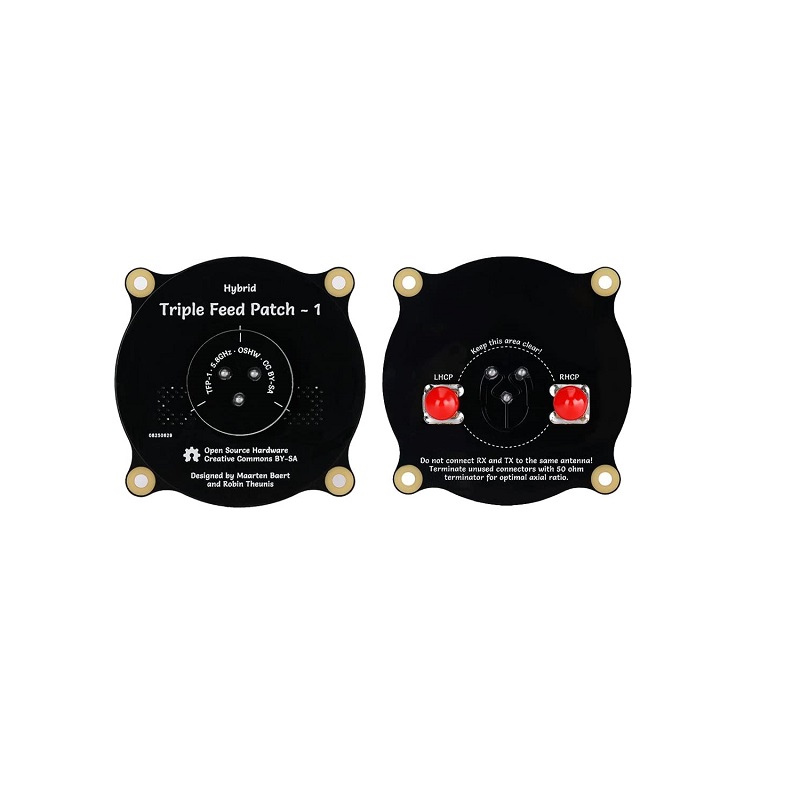

SPIDER Automation | 5.8GHz Triple Feed Directional Patch Antenna | 9.4dBi Circularly Polarized FPV Antenna
Product Overview & Antenna Design
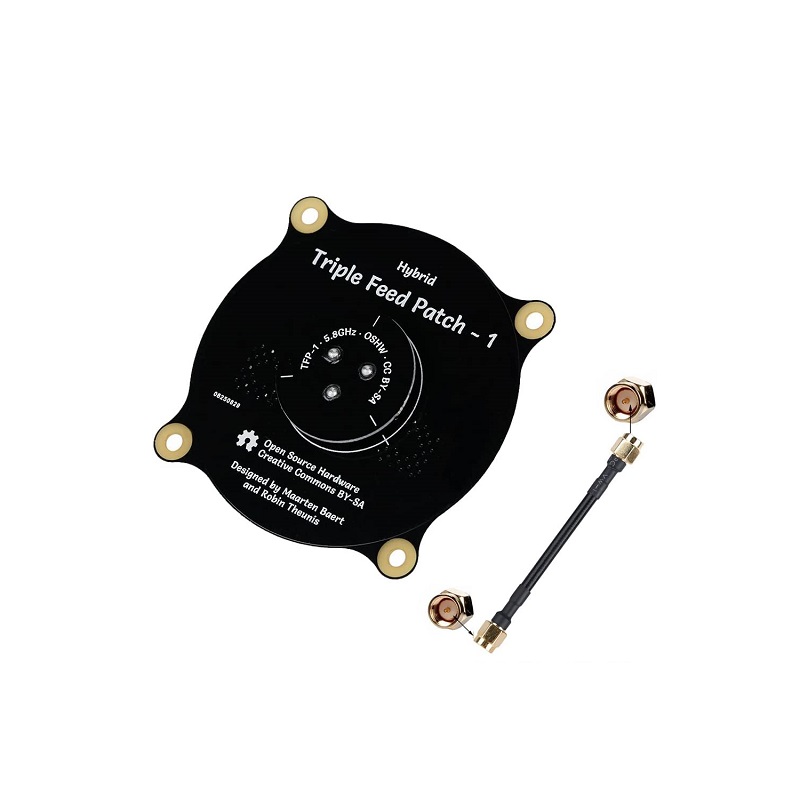
The SPIDER Automation 5.8GHz Triple Feed Patch Antenna is a directional circularly polarized antenna developed for 5.8GHz FPV video transmission and reception systems. Its patch-based radiating structure uses a triple-feed configuration to support circular polarization, making it suitable for RF installations where directional coverage and polarization characteristics are important.
Unlike an omnidirectional antenna, a directional patch antenna concentrates its radiation or reception pattern within a more defined angular region. This makes antenna positioning and alignment important when establishing an RF link. The antenna has a stated 9.4dBi gain and a 55° half-power beamwidth in both horizontal and vertical planes.
The design is also specified with a radiation efficiency figure of 0.835 and favourable axial-ratio characteristics, including at off-centre angles. These characteristics are relevant to circularly polarized antenna performance, where maintaining polarization quality across the useful coverage area can influence link consistency.
Technical Features & Performance Characteristics
- Triple-Feed Patch Architecture: The antenna uses three feed points in its patch configuration to produce circular polarization. This architecture is intended to support the required phase and field relationships for circularly polarized operation.
- Directional RF Coverage: The patch structure provides a defined radiation pattern rather than uniform coverage in all directions. Correct orientation towards the intended communication area is therefore important.
- Circular Polarization: Circular polarization can help reduce sensitivity to relative antenna rotation compared with linearly polarized antenna arrangements. The transmitting and receiving antenna polarization should still be compatible for effective RF performance.
- 9.4dBi Gain Rating: The stated antenna gain indicates directional RF performance. Actual link performance depends on installation, alignment, cable losses, transmitter power, receiver sensitivity and the surrounding RF environment.
- 55° Half-Power Beamwidth: The specified beamwidth in both horizontal and vertical planes defines the approximate angular region around the main radiation direction where power remains within 3dB of the peak level.
- Axial Ratio Characteristics: The design is described as maintaining favourable axial-ratio performance both directly in front of the patch and at off-centre angles. Axial ratio is an important parameter for evaluating the quality of circular polarization.
- Radiation Efficiency: The stated efficiency figure of 0.835 represents the reported proportion of accepted RF power converted into radiated power. It should not be confused with total system efficiency or antenna gain.
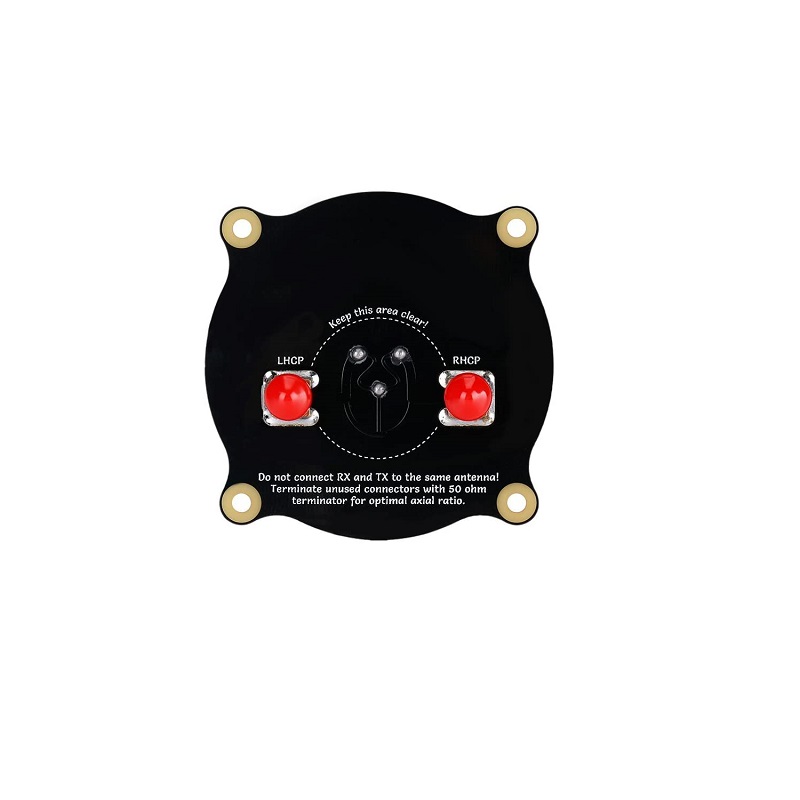
- SMA RF Connection: The antenna is specified with an SMA male connector. The supplied coaxial cable also has SMA male connectors at both ends, so the mating interfaces on connected equipment must be checked before installation.
RF Connectivity & Installation
The antenna is supplied with a semi-rigid coaxial cable featuring SMA male connectors at both ends. This cable is intended to provide the RF connection between the patch antenna and compatible equipment. Before connecting, verify the connector gender and SMA interface compatibility at both ends of the intended RF path.
As a directional antenna, the patch should be positioned so that its main radiation or reception direction faces the intended RF link. For FPV systems, the antenna’s circular polarization should be matched with the corresponding antenna polarization on the other side of the link. Physical obstructions, antenna orientation, coaxial cable routing and nearby conductive structures can affect actual RF performance.
Applications
The 5.8GHz Triple Feed Patch Antenna is suitable for compatible RF systems that require directional circularly polarized antenna coverage. Potential applications include:
- FPV Video Systems: Directional antenna installations for compatible 5.8GHz first-person-view video links.
- FPV Ground Stations: Directional reception setups where the antenna can be aligned towards the operating area.
- FPV Video Receivers: Use with compatible 5.8GHz receivers that support the antenna’s RF connector and polarization arrangement.
- Wireless Video Links: Directional RF links using compatible 5.8GHz circularly polarized equipment.
- RC Communication Systems: Suitable for compatible radio-control video or RF subsystems operating in the specified band.
- Directional RF Experiments: Antenna evaluation and testing involving gain, beamwidth and circular-polarization characteristics.
- RF Development Setups: Integration into compatible 5.8GHz antenna prototypes and communication test arrangements.
Package Includes
- 1 × 5.8GHz Triple Feed Patch Antenna with SMA male connector
- 1 × Semi-rigid coaxial cable with SMA male-to-SMA male connectors
Note: The rubber cap shown in some older product images has been discontinued and is not included.
Product Specifications
| Parameter | Specification |
|---|---|
| Product Type | Triple Feed Patch Antenna |
| Operating Frequency | 5.8GHz |
| Antenna Type | Directional Patch Antenna |
| Polarization | Circular Polarization |
| Gain | 9.4dBi |
| Half-Power Beamwidth | 55° Horizontal / 55° Vertical |
| Radiation Efficiency | 0.835 (83.5%) |
| Antenna Connector | SMA Male |
| Included Coaxial Cable | Semi-rigid coaxial cable |
| Coaxial Cable Connectors | SMA Male to SMA Male |
| Shipping Weight | 0.022kg |
| Shipping Dimensions | 13 × 9 × 1cm |
Connection & Operating Recommendations
For reliable integration into a 5.8GHz RF system, verify the antenna interface, polarization and installation orientation before operation. The following recommendations help maintain appropriate RF connectivity and avoid unnecessary signal loss:
- Verify Connector Compatibility: Confirm that the connected equipment uses a compatible SMA interface. Do not assume SMA and RP-SMA connectors are interchangeable.
- Match Polarization: Use a compatible circularly polarized antenna at the opposite end of the RF link. Check the required polarization handedness before installation.
- Align the Directional Antenna: Point the patch towards the intended communication area and account for its 55° horizontal and vertical half-power beamwidth.
- Minimize Coaxial Loss: Keep the RF cable routing practical and avoid unnecessary cable length, sharp bends or mechanical stress on the semi-rigid cable.
- Secure RF Connections: Ensure connectors are properly seated and avoid excessive tightening that could damage the connector interface.
- Maintain a Clear RF Path: Where practical, position the antenna away from large conductive obstructions that could alter its radiation pattern or interfere with the RF link.
- Check System Compatibility: Confirm that the connected transmitter or receiver operates at 5.8GHz and supports the antenna’s connector and RF requirements.