
SPIDER Automation | GT2205 2300KV CCW Brushless Outrunner Motor – Silver Cap | 495W FPV Multirotor Propulsion
Description
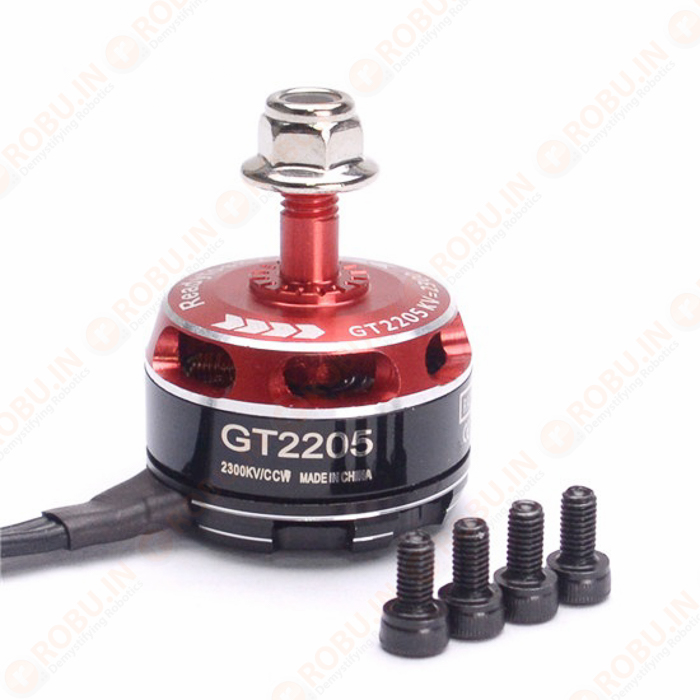
The GT2205 2300KV CCW Brushless DC Outrunner Motor – Silver Cap is designed for compatible FPV racing drones, quadcopters and compact multirotor propulsion systems using 5-inch propellers. It features a 2300KV speed constant and curved N52 high-temperature magnets. The motor is specified for 2S–4S LiPo battery configurations, with a 40–60A ESC range identified in the supplied configuration information.
Its mechanical construction incorporates quality bearings, a strong retaining C-clip and a 5mm shaft. The listed motor weight is approximately 35g. Electrical specifications include 65mΩ internal resistance, 600mA no-load current, 20A current handling capacity, 30A maximum-efficiency current and maximum efficiency above 81%. The source also lists a maximum power rating of 495W; actual power demand and thermal performance depend on the battery, ESC and propeller combination.
This is the CCW (counter-clockwise) rotation version with a silver cap. Four socket-head cap (Allen) bolts are included for motor fitting. The source identifies limited exposed cooling fins, so airflow and thermal management should be considered during installation and propulsion testing.
Motor Configuration & Electromagnetic Design
The GT2205 motor uses a 2300KV speed constant and curved N52 high-temperature magnets. The magnets are described as thin, wide and curved, forming part of the motor’s electromagnetic construction. The KV rating represents a nominal no-load speed constant in RPM per volt, not a guaranteed loaded operating speed.
- GT2205 Motor Format: Brushless outrunner motor configuration identified by the GT2205 model designation.
- 2300KV Rating: Nominal speed constant of 2300 RPM per volt under no-load reference conditions.
- N52 Magnet Grade: Uses N52 magnets as specified in the source.
- High-Temperature Magnet Design: Magnets are described as suitable for high-temperature motor operation; no specific magnet temperature limit is provided.
- Curved Magnet Geometry: Features thin, wide and curved magnets as part of the electromagnetic design.
- Motor Rotation: CCW (counter-clockwise) rotation version.
- Silver Cap: Silver-cap variant for identification within the GT2205 motor range.
- Internal Resistance: Listed at 65mΩ.
- No-Load Current: 600mA under no-load conditions.
- Current Handling Capacity: 20A as listed in the source; the rating duration and continuous/peak classification are not supplied.
- Maximum-Efficiency Current: 30A at the listed maximum-efficiency operating point.
- Maximum Efficiency: Greater than 81% according to the source specifications.
Mechanical Construction & Shaft Retention
The motor features a compact mechanical assembly with quality bearings and a retaining C-clip. The C-clip helps retain the shaft assembly during operation, while the bearing arrangement supports smooth rotation. Its approximately 35g weight makes it suitable for multirotor designs where propulsion component mass is an important consideration.
- Quality Bearing Assembly: Bearings are identified as a construction feature supporting smooth motor operation.
- Retaining C-Clip: Strong C-clip construction helps secure the shaft assembly.
- 5mm Shaft: Provides the stated shaft diameter for compatible adapter selection.
- Silver Cap Configuration: Identifies this particular GT2205 motor variant.
- Lightweight Motor: Listed weight of approximately 35g.
- Mounting Hardware: Four socket-head cap (Allen) bolts are included for motor fitting.
- Compact Propulsion Format: GT2205 motor designation for compatible multirotor frame installations.
Electrical Compatibility & Propulsion Configuration
The GT2205 2300KV motor is specified for 2S–4S LiPo battery systems. The supplied configuration information identifies a 40–60A ESC range and 5-inch propellers. These are system-selection references rather than a guarantee that every ESC or propeller within those categories will be suitable. Actual current demand must be evaluated with the intended battery and propeller combination.
- Battery Compatibility: Specified for compatible 2S, 3S and 4S LiPo battery configurations.
- Maximum Power Rating: 495W as stated in the source specifications.
- ESC Range: A 40–60A ESC is identified in the source configuration information.
- Propeller Size Reference: 5-inch propeller configuration.
- No-Load Current: 600mA listed without normal propeller load.
- Current Handling Capacity: 20A as stated; rating duration and test conditions are not supplied.
- Maximum-Efficiency Current: 30A listed at the maximum-efficiency operating point.
- Internal Resistance: 65mΩ source-listed motor resistance.
- Maximum Efficiency: Greater than 81% as stated in the source specifications.
Thermal Management & Cooling Considerations
The supplied description identifies limited exposed cooling fins as a potential limitation of the motor’s self-cooling arrangement. Airflow and operating temperature should therefore be considered when selecting the motor’s propeller, ESC and installation position. High-load operation should be evaluated under the actual aircraft configuration rather than relying on the motor’s KV rating or efficiency figure alone.
- Limited Exposed Cooling Fins: The source notes a lack of prominent exposed fins for heat dissipation.
- Airflow Consideration: Allow suitable airflow around the motor during operation.
- Load Matching: Select a propeller that keeps motor current and temperature within verified operating limits.
- Thermal Monitoring: Check motor temperature during initial testing and after changes to battery voltage or propeller configuration.
- Installation Clearance: Avoid mounting arrangements that unnecessarily obstruct airflow around the motor.
Applications
The GT2205 2300KV CCW motor is intended for compatible compact brushless multirotor propulsion systems. Its 2300KV rating, 2S–4S battery compatibility and 5-inch propeller reference make it relevant to the following applications when the complete propulsion system is correctly matched.
- FPV Racing Quadcopters: CCW motor installation in compatible FPV racing aircraft.
- 5-Inch FPV Drones: Propulsion integration in multirotor frames designed for compatible 5-inch propellers.
- Compact Racing Multirotors: Brushless motor integration in lightweight racing-oriented aircraft.
- 2S LiPo Drone Systems: Use in compatible 2S battery-powered propulsion configurations.
- 3S LiPo Drone Systems: Use in appropriately matched 3S battery-powered propulsion configurations.
- 4S LiPo Drone Systems: Use in suitably matched 4S battery-powered propulsion configurations.
- CCW Motor Positions: Installation in aircraft positions requiring counter-clockwise motor rotation.
- Multirotor Frame Assembly: Motor fitting in compatible frames with matching mounting provisions.
- UAV Propulsion Development: Component-level integration in suitable unmanned aircraft development projects.
- FPV Aircraft Prototyping: Evaluation of brushless propulsion arrangements for FPV aircraft designs.
- Brushless ESC Integration: Use with compatible ESCs selected according to battery voltage and actual motor load.
- Propeller Load Evaluation: Testing compatible 5-inch propeller configurations within verified operating limits.
- Motor Replacement: Replacement of compatible GT2205-format CCW motors after checking shaft, mounting and electrical requirements.
- Motor Performance Testing: Evaluation of current draw, rotational behaviour and efficiency under controlled test conditions.
- Multirotor Propulsion Prototyping: Development and assessment of compact brushless motor and propeller combinations.
Package Includes
- 1 × GT2205 2300KV CCW Brushless DC Outrunner Motor – Silver Cap
- 4 × Socket-Head Cap (Allen) Bolts for Motor Fitting
Note: Propeller, propeller adapter, ESC and battery are not listed as included package items.
Product Specifications
| Parameter | Specification |
|---|---|
| Product Type | Brushless DC Outrunner Motor |
| Motor Model | GT2205 |
| Motor KV | 2300KV |
| Nominal Speed Constant | 2300 RPM/V (no-load reference) |
| Rotation Direction | CCW – Counter-Clockwise |
| Cap Colour | Silver |
| Magnet Grade | N52 |
| Magnet Type | High-Temperature Magnets |
| Magnet Geometry | Thin, Wide and Curved |
| Maximum Power | 495W |
| No-Load Current | 600mA |
| Current Handling Capacity | 20A (rating duration/classification not provided) |
| Maximum-Efficiency Current | 30A |
| Maximum Efficiency | >81% |
| Internal Resistance | 65mΩ |
| Compatible Battery Chemistry | LiPo |
| Compatible Battery Configuration | 2S–4S |
| Recommended ESC Range | 40–60A |
| Propeller Size Reference | 5 Inch |
| Shaft Diameter | 5mm |
| Bearing Type | Quality Bearings (specific bearing model not provided) |
| Shaft Retention | C-Clip Retainer |
| Motor Weight | Approximately 35g |
| Mounting Hardware | 4 × Socket-Head Cap (Allen) Bolts |
| Cooling Design Note | Limited exposed cooling fins, as described in the source |
Installation & Operating Recommendations
- Verify Battery Voltage: Use a compatible 2S–4S LiPo configuration and confirm that the selected battery, ESC and motor are suitable for the intended operating conditions.
- Select a Suitable ESC: The source recommends a 40–60A ESC range. Verify its voltage rating, current capability and cooling requirements before installation.
- Match the Propeller: Use a compatible 5-inch propeller configuration and evaluate actual current draw under load before regular operation.
- Check Adapter Compatibility: Confirm that the propeller adapter matches the motor’s 5mm shaft and the selected propeller hub.
- Confirm CCW Rotation: This is the CCW version. Verify the required motor direction and propeller orientation for the aircraft layout.
- Secure Motor Mounting: Use the included four Allen bolts with compatible frame mounting points. Confirm screw length and clearance before tightening.
- Check Shaft Retention: Inspect the C-clip and shaft assembly for correct seating before operation.
- Allow Adequate Airflow: Avoid installations that obstruct airflow around the motor, particularly because the source notes limited exposed cooling fins.
- Monitor Temperature and Current: Check motor temperature and current draw during initial testing, especially when changing propeller size or battery configuration.
- Test Before Flight: Verify rotation, mounting security and ESC response in a controlled test environment before installing propellers for flight.