



SPIDER Automation | BBC Micro:Bit V2.21 Go Kit – nRF52833, Bluetooth 5.1, Integrated Sensors & 25-Pin Expansion Interface
Product Overview & Embedded Development Platform
The BBC Micro:Bit V2.21 Go Kit is a compact, programmable microcomputer designed to support coding, electronics experimentation and interactive embedded development. It builds on the capabilities of the original Micro:Bit platform while retaining compatibility with existing lessons and code developed for the earlier device, as stated in the supplied product information.
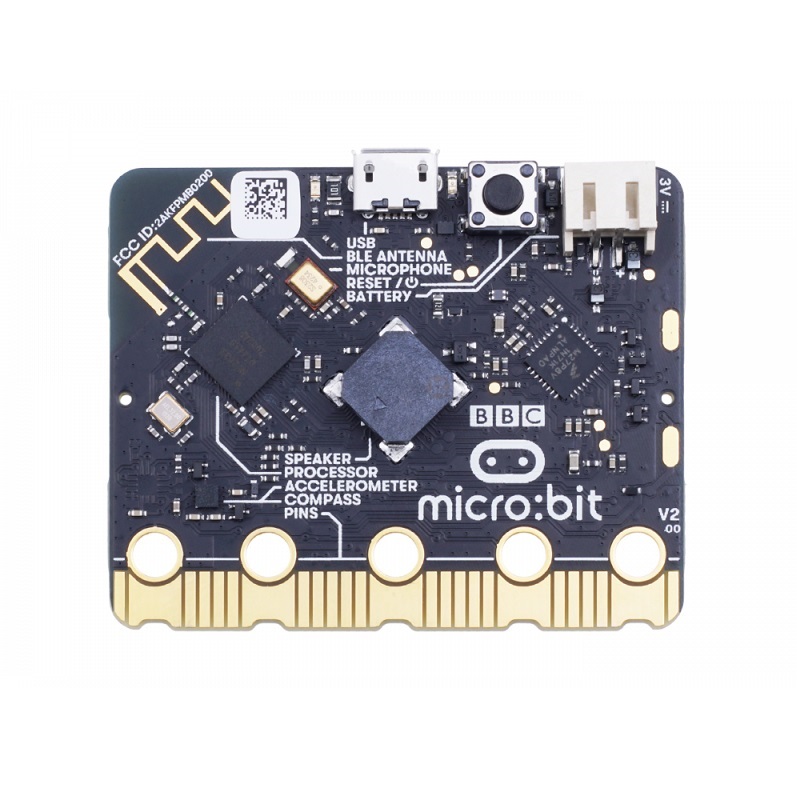
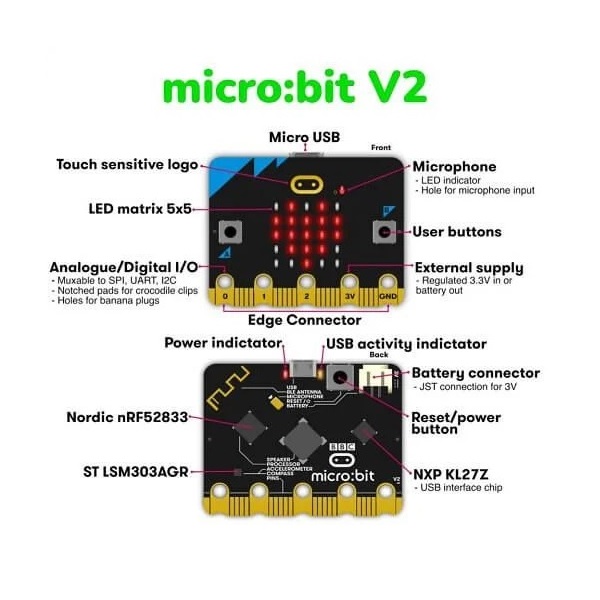
The V2.21 board features an upgraded Nordic nRF52833 microcontroller with 512KB Flash memory and 128KB RAM. Wireless capabilities include Bluetooth 5.1, Bluetooth Low Energy (BLE) and 2.4GHz radio communication. The board also includes a separate USB-handling microcontroller, upgraded from KL26Z to KL27Z, with 32KB RAM.
Its integrated hardware combines a 5×5 red LED matrix, two programmable buttons, a touch-sensitive Micro:Bit logo, MEMS microphone, accelerometer, compass, light sensor and temperature sensor. These features allow developers to create applications that respond to user inputs, sound, movement, orientation and environmental conditions.
The board provides a 25-pin edge connector with dedicated GPIO and peripheral interfaces, along with five notched ring pins for external connections. Micro-USB Type-B and JST-PH battery connectors provide different power options. The Go Kit includes the essential accessories required to get started, including a USB cable, battery holder, two AAA batteries and a user guide.
Technical Features & Performance Characteristics
- Upgraded nRF52833 Microcontroller: Uses the nRF52833 as its main microcontroller, providing 512KB Flash memory and 128KB RAM for running programmed applications.
- Upgraded USB Co-Microcontroller: Features the KL27Z USB-handling co-microcontroller with 32KB RAM, replacing the KL26Z used in the earlier hardware configuration described in the source.
- 5×5 Red LED Matrix: Contains 25 LEDs for displaying visual patterns, animations, scrolling messages and other programmed outputs.
- Two Programmable Buttons: Provides two onboard buttons for user interaction and program control.
- Touch-Sensitive Micro:Bit Logo: Adds a touch-input function through the integrated logo area.
- Integrated MEMS Microphone: Provides microphone input for sound-responsive applications, with a separate microphone input indicator LED.
- Onboard Accelerometer: Supports motion and orientation-based functions in applications that use movement as an input.
- Integrated Compass: Provides directional sensing for compass-based and orientation-aware applications.
- Light and Temperature Sensors: Adds onboard environmental sensing capabilities for applications involving light and temperature measurements.
- Bluetooth 5.1 and BLE: Supports Bluetooth wireless communication, including Bluetooth Low Energy functionality.
- 2.4GHz Radio: Provides an additional wireless communication capability for supported Micro:Bit applications.
- 25-Pin Edge Connector: Provides 20 smaller-pitch pins and five notched ring pins for connecting external circuits and accessories.
- Dedicated Peripheral Interfaces: Supports GPIO, PWM, I2C and SPI connections for interfacing with external electronic components and peripherals.
- Five Ring Connectors: The five ring pins support connections using crocodile clips or banana plugs.
- Dedicated I2C Bus: Provides a dedicated I2C bus for connecting supported peripheral devices.
- Power and Reset Controls: Includes a power button for switching off the MCU and a reset button with a status LED.
- Power Indicator LEDs: Includes a power indicator LED and a separate microphone input indicator LED.
- Micro-USB Type-B Connector: Provides a USB connection for programming and USB-based power.
- JST-PH Battery Connector: Provides a battery connection using a JST-PH connector, as specified in the supplied product information.
- External Accessory Current: Provides up to 200mA of available current for external devices and accessories, according to the supplied specification.
- Multiple Programming Platforms: Supports programming through C++, MakeCode, Python and Scratch.
Performance Advantages
- Enhanced Processing Resources: The nRF52833 controller, 512KB Flash and 128KB RAM provide upgraded memory resources compared with the original Micro:Bit configuration described in the source.
- Integrated Input and Output Functions: Combines buttons, touch input, microphone, sensors and LED display functionality on one compact development board.
- Multiple Wireless Options: Bluetooth 5.1, BLE and 2.4GHz radio provide wireless communication capabilities for supported applications.
- Expanded Hardware Connectivity: The 25-pin edge connector, five ring pins and dedicated peripheral interfaces support connections to external electronic circuits and devices.
- Flexible Power Configuration: Supports 5V power through Micro-USB and 3V power through the edge connector or battery pack.
- Ready-to-Use Accessory Kit: The included USB cable, battery holder, AAA batteries and user guide provide the essential accessories for getting started.
Industrial, Commercial & Educational Applications
- Embedded Design & Development: Prototyping and development of compact programmable embedded systems.
- Programming Education: Practical learning and software development using supported programming platforms.
- Sensor-Based Applications: Developing systems using accelerometer, compass, light and temperature sensor inputs.
- Sound-Responsive Electronics: Creating applications that use the integrated MEMS microphone as an input.
- Wireless Communication Projects: Developing connected applications using Bluetooth 5.1, BLE and 2.4GHz radio.
- Interactive Control Systems: Using the programmable buttons and touch-sensitive logo for user-input functions.
- LED Display Applications: Creating programmable visual indicators, animations, patterns and scrolling messages.
- External Hardware Interfacing: Connecting supported sensors, peripherals and electronic circuits through the edge connector and ring pins.
Package Contents
- 1 × BBC Micro:Bit V2.21 Go Board
- 1 × USB Cable
- 1 × Battery Holder
- 1 × User Guide
- 2 × AAA Batteries
Product Specifications
| Parameter | Specification |
|---|---|
| Product Name | BBC Micro:Bit V2.21 Go Kit |
| Main Microcontroller | nRF52833 |
| Flash Memory | 512KB |
| RAM | 128KB |
| USB Co-Microcontroller | KL27Z |
| USB Co-Microcontroller RAM | 32KB |
| LED Matrix | 5 × 5 matrix, 25 red LEDs |
| Programmable Buttons | 2 |
| Touch Input | Touch-sensitive Micro:Bit logo |
| Microphone | Built-in MEMS microphone |
| Onboard Sensors | Accelerometer, compass, light sensor and temperature sensor |
| Motion Sensor Specification | ST LSM303 (as supplied) |
| Wireless Connectivity | Bluetooth 5.1, Bluetooth Low Energy (BLE) and 2.4GHz radio |
| Edge Connector | 25 pins: 20 smaller-pitch pins and 5 notched ring pins |
| Peripheral Interfaces | GPIO, PWM, I2C and SPI |
| Ring Connectors | 5 notched ring pins; supports crocodile clips or banana plugs |
| I2C Interface | Dedicated I2C bus for peripherals |
| USB Connector | Micro-USB Type-B |
| Battery Connector | JST-PH |
| Power Rating | 5V via Micro-USB; 3V via edge connector or battery pack |
| Power Control | Power button; push and hold to power off the MCU |
| Reset Function | Reset button with status LED |
| Indicator LEDs | Power indicator LED and microphone input indicator LED |
| Available Current for External Devices | 200mA |
| Programming Platforms | C++, MakeCode, Python and Scratch |
| Length | 50mm |
| Width | 40mm |
| Height | 10mm |
| Product Weight | 20g (as supplied) |
| Shipping Weight | 0.25kg |
| Shipping Dimensions | 12 × 8 × 3cm |
Installation & Operating Recommendations
- USB Programming: Connect the board to a computer using the included USB cable for programming and USB-based power.
- Battery Operation: Use the included battery holder and AAA batteries with the board’s JST-PH battery connection.
- External Power Input: Observe the specified 5V Micro-USB and 3V edge connector or battery-pack power options when selecting a power source.
- Peripheral Connections: Verify pin assignments and electrical requirements before connecting external sensors, modules or other devices to the edge connector.
- External Accessory Current: Keep the total current drawn by connected external devices within the stated 200mA available-current specification.
- Wireless Configuration: Use supported Bluetooth 5.1, BLE or 2.4GHz radio functions according to the requirements of the application.


