
SPIDER Automation | 3S 8A 18650 Li-ion Battery Protection Board | 11.1V 12.6V
Product Overview
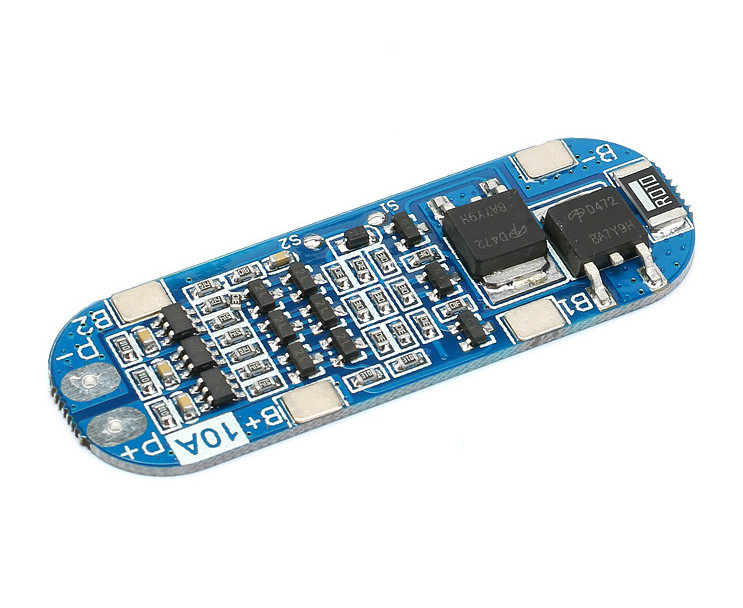
The SPIDER Automation 3S 8A 18650 Li-ion Battery Protection Board is designed for three-cell series-connected rechargeable lithium-ion battery packs. It integrates cell-voltage monitoring and electronic protection functions to help protect the battery assembly against overcharging, excessive discharge, overcurrent and short-circuit conditions.
The board supports conventional 3.7V nominal Li-ion cells arranged in a 3S configuration. Its cell-monitoring connections provide access to the individual series-cell junctions, while its compact PCB construction makes it suitable for custom battery assemblies, portable electronics and compatible backup power applications.
Technical Features & Protection Functions
- Overcharge Protection: Monitors individual cell voltage and provides protection when a cell reaches the specified overcharge detection threshold.
- Over-Discharge Protection: Detects excessive discharge voltage to help prevent individual cells from being discharged beyond the specified threshold.
- Overcurrent Protection: Detects excessive current conditions to help protect the battery pack and connected electrical system.
- Short-Circuit Protection: Provides a protective response during short-circuit conditions.
- Cell-Voltage Monitoring: Uses the battery connection points to monitor the three series-connected cells individually.
- Low Standby Current: The low resting-current design helps reduce unnecessary battery consumption while the board is in standby.
- Delayed Self-Recovery: Incorporates a recovery delay following supported protection events. Normal operation depends on the fault condition being cleared.
3S Battery Configuration & Voltage Requirements
This protection board is designed for a 3S lithium-ion battery configuration, consisting of three compatible Li-ion cells connected in series. The combined battery voltage is higher than that of an individual cell, while the same current flows through all three series-connected cells.
For conventional 3.7V nominal Li-ion cells, the resulting battery pack has an 11.1V nominal voltage and a 12.6V full-charge voltage. Charging must be performed using a dedicated 12.6V CC/CV charger suitable for a 3S Li-ion battery pack.
Important: This module is a battery protection board, not a standalone battery charger. It does not replace the external charging controller required to regulate the charging process.
Cell Connection & Wiring Details
The board uses four battery connection points to monitor the three series-connected cells. Connect each terminal to the corresponding point in the battery pack as shown below.
| Terminal | Battery Connection |
|---|---|
| B− | Negative terminal of the complete 3S battery pack (0V reference). |
| B1 | Junction between the first and second cells (approximately 3.7V nominal relative to B−). |
| B2 | Junction between the second and third cells (approximately 7.4V nominal relative to B−). |
| B+ | Positive terminal of the complete 3S battery pack (approximately 11.1V nominal relative to B−). |
Wiring sequence: Connect the battery negative, first cell junction, second cell junction and battery positive to their corresponding terminals. Verify the polarity and voltage at every connection point before connecting the external circuit.
Functional Advantages
- Individual Cell Monitoring: Provides intermediate cell connections for monitoring the voltage of all three series-connected cells.
- Integrated Electrical Protection: Combines multiple battery protection functions in a single compact module.
- Reduced Standby Consumption: Low resting current helps limit power consumption when the battery system is idle.
- Compact Integration: The slim PCB format is suitable for custom battery assemblies with limited installation space.
- Practical Battery Pack Design: Supports the development of compatible 3S rechargeable battery-powered equipment.
Applications
This 3S Li-ion battery protection board is suitable for compatible 11.1V nominal battery assemblies where the cell chemistry, discharge capability and electrical load requirements match the board’s specifications.
- Custom 18650 Battery Packs: Protection for three-cell series-connected rechargeable Li-ion battery assemblies.
- Rechargeable Massagers: Battery protection in compatible portable massager designs.
- LED Lighting Systems: Protection for suitable 3S Li-ion-powered LED lighting assemblies.
- 12V Electronic Equipment: Battery protection for compatible electronic devices designed for an 11.1V nominal battery supply.
- Solar Street Lighting: Integration into compatible solar lighting battery systems designed around a 3S Li-ion pack.
- Backup Monitoring Systems: Protection for suitable rechargeable battery backup supplies used in monitoring equipment.
- Portable Electronics: Battery protection for compatible portable electronic products.
- Embedded Control Systems: Integration into battery-powered electronic controllers and monitoring units.
- DIY Battery Projects: Protection circuitry for custom-built 3S lithium-ion battery packs.
- Low-Power Robotics: Battery protection for compatible robotic electronics operating within the board’s electrical limits.
Package Contents
- 1 × 3S 8A 18650 Li-ion Battery Protection Board
Product Specifications
| Parameter | Specification |
|---|---|
| Product Type | Li-ion Battery Protection Board |
| Battery Configuration | 3S (3 cells connected in series) |
| Compatible Battery Chemistry | Conventional rechargeable Li-ion |
| Compatible Cell Format | 18650 and compatible Li-ion cells |
| Nominal Cell Voltage | 3.7V |
| Nominal Pack Voltage | 11.1V |
| Full-Charge Pack Voltage | 12.6V |
| Recommended Charging Voltage | 12.6V CC/CV |
| Working Current | 8A |
| Current Limit / Overcurrent Protection | 13A |
| Overcharge Detection Voltage | 4.25 ± 0.025V per cell |
| Over-Discharge Detection Voltage | 2.50 ± 0.08V per cell |
| Protection Functions | Overcharge, over-discharge, overcurrent and short-circuit protection |
| Resting Current | Less than 30µA |
| Internal Resistance | Less than 100mΩ |
| Recovery Behaviour | Delayed self-recovery |
| Operating Temperature | −40°C to +50°C |
| Storage Temperature | −40°C to +80°C |
| Battery Connection Terminals | B−, B1, B2, B+ |
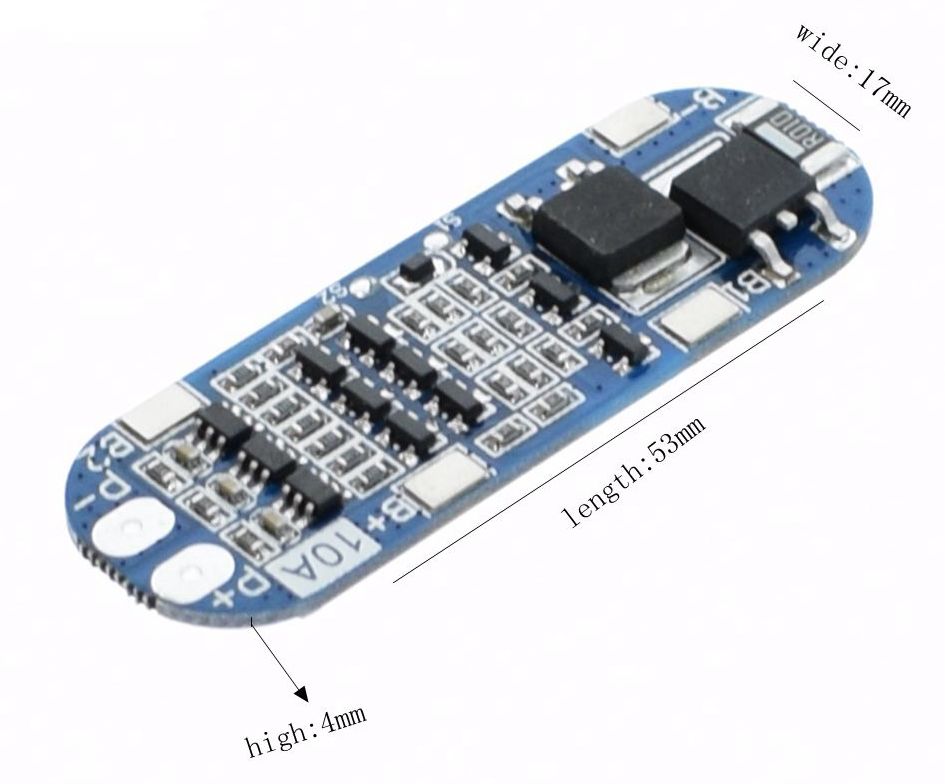
| PCB Length | 54mm |
| PCB Width | 17.5mm |
| PCB Height | 4mm |
| Product Weight | Approximately 4g |
Connection & Operating Recommendations
- Correct 3S Cell Arrangement: Connect three compatible conventional Li-ion cells in series. Do not connect the board as a 1S or 2S protection module.
- Follow Terminal Sequence: Connect B−, B1, B2 and B+ to the corresponding battery negative, cell junctions and battery positive points. Incorrect wiring can damage the board.
- Verify Cell Voltages: Before connecting the pack, check that all three cells have compatible voltage levels. Avoid assembling a series pack with significantly different cell voltages.
- Use a Dedicated Charger: Use a suitable 12.6V CC/CV charger for conventional 3S Li-ion cells. Do not use a 12V power supply as a substitute for a proper Li-ion charger.
- Match Battery Discharge Capability: The protection board’s current rating does not increase the discharge capability of the cells. Select cells capable of safely supplying the intended load.
- Manage Continuous Load: Keep the continuous operating current within the board’s specified working-current rating. Consider PCB heating, wiring resistance, ventilation and enclosure conditions.
- Account for Startup Current: Motors and other inductive loads can draw substantial startup current. Verify that their startup and operating current requirements are compatible with the protection board.
- Monitor Battery Temperature: Stop operation if any cell becomes unusually hot during charging or discharging. Investigate the battery, load and wiring before further use.
- Check Fault Conditions: Clear short circuits and excessive loads before attempting to restore normal operation after a protection event.