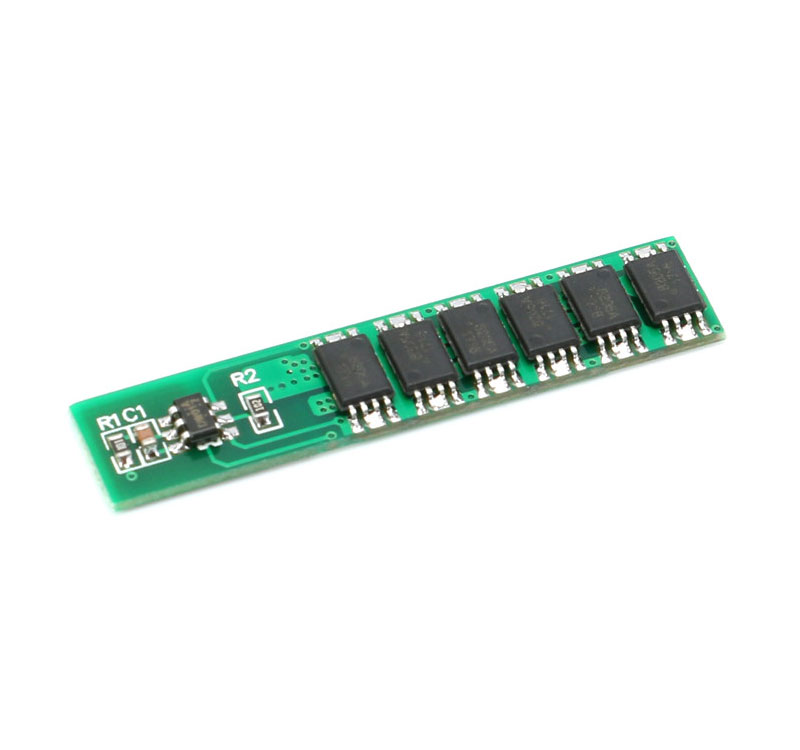

SPIDER Automation | 1S 12A 6-MOSFET 18650 Lithium-Ion Battery Protection Board | DW01 + 8205A
The SPIDER Automation 1S 6-MOSFET Lithium-Ion Battery Protection Board is designed to provide electrical protection for single-cell rechargeable Li-ion battery packs. It monitors battery voltage and current conditions and controls the protected charge and discharge paths to help prevent damage caused by abnormal operating conditions.
Based on the DW01 protection IC and 8205A MOSFET components, the module integrates multiple battery protection functions into a compact PCB. Its separate battery and protected output terminals support straightforward integration into compatible 18650 battery assemblies and custom electronic projects.
Technical Features & Protection Functions
- Overcharge Protection: Monitors cell voltage and disconnects the protected charging path when the overcharge threshold is reached.
- Over-Discharge Protection: Helps prevent excessive battery discharge by disconnecting the protected circuit when the cell reaches its lower voltage threshold.
- Overcurrent Protection: Detects excessive current conditions and helps protect the battery and connected load.
- Short-Circuit Protection: Provides a protective response to output short-circuit conditions.
- DW01 Protection Controller: Provides battery voltage monitoring and protection control.
- 6-MOSFET Switching Arrangement: Uses a multi-MOSFET power stage for controlling the protected battery connection.
- Common Charge/Discharge Port: Uses the same protected terminals for charger and load connections.
Electrical Connections & Terminal Functions
The board provides separate battery-side and protected circuit connection points. The battery connects to B+ and B−, while the external charger and load connect through P+ and P−. Correct polarity is essential for proper operation.
| Terminal | Connection Function |
|---|---|
| B+ | Connect to the positive terminal of the battery cell or parallel battery group. |
| B− | Connect to the negative terminal of the battery cell or parallel battery group. |
| P+ | Protected positive connection for the external charger and load. |
| P− | Protected negative connection for the external charger and load. |
Compact PCB Design & Battery Integration
The narrow PCB format allows the protection circuit to be incorporated into compatible battery assemblies where mounting space is limited. The board is intended for single-cell battery configurations, including suitable parallel-connected cells that operate as one electrical cell group.
- Compact protection PCB for custom battery-pack integration.
- Separate battery and protected output terminals.
- Compatible with single-cell 18650 Li-ion battery arrangements.
- Can be used with matched parallel-connected cells when the complete battery group is designed and assembled correctly.
Applications
This protection board can be integrated into compatible single-cell lithium-ion battery systems where battery voltage and output-current protection are required.
- 18650 Battery Packs: Protection circuitry for single-cell rechargeable battery assemblies.
- DIY Power Banks: Protection stage for compatible single-cell power-bank designs.
- Portable Electronics: Battery protection for rechargeable handheld electronic devices.
- LED Lighting Projects: Protection for compatible battery-powered LED circuits.
- Wireless Devices: Battery protection for suitable wireless electronic equipment.
- IoT Projects: Integration into rechargeable battery-powered sensor and monitoring devices.
- Microcontroller Projects: Protected battery supply for compatible embedded development systems.
- Portable Instruments: Battery protection for suitable portable measurement and testing equipment.
- DIY Robotics: Use in compatible low-voltage electronic and control assemblies.
- Custom Battery Assemblies: Integration into single-cell battery-powered prototypes and electronic products.
Package Contents
- 1 × 1S 18650 3.7V Lithium-Ion Battery Protection Board – 6 MOSFET
Product Specifications
| Parameter | Specification |
|---|---|
| Product Type | Lithium-Ion Battery Protection Board / BMS |
| Battery Configuration | 1S – Single Cell |
| Compatible Battery | Conventional 3.7V Nominal 18650 Li-ion Cell |
| Nominal Battery Voltage | 3.7V |
| Full-Charge Voltage | 4.2V |
| Maximum Continuous Current | 12A (listed maximum; thermal conditions apply) |
| Overcurrent Detection Current | 15A |
| Overcharge Detection Voltage | 4.25V ± 0.05V (feature specification) |
| Overcharge Release Voltage | 4.23V ± 0.05V |
| Over-Discharge Detection Voltage | 2.45V ± 0.1V (feature specification) |
| Protection IC | DW01 |
| MOSFET Arrangement | 6 MOSFET |
| MOSFET Component | 8205A |
| Operating Temperature | -40°C to +85°C |
| Battery Terminals | B+, B− |
| Protected Port | P+, P− (Shared Charge/Discharge) |
| PCB Length | 35.5mm |
| PCB Width | 8mm |
| PCB Height | 2mm |
| Product Weight | 1g |
Connection & Operating Recommendations
- Use Compatible Cells: Connect only to a conventional single-cell lithium-ion battery or a correctly assembled parallel group. Do not use this board for series-connected battery packs.
- Match Parallel Cells: For parallel configurations, use cells with compatible chemistry, voltage, capacity and condition. Bring cells to an appropriate matching voltage before connecting them in parallel.
- Observe Polarity: Verify B+ and B− battery connections and P+ and P− protected connections before powering the circuit.
- Use a Dedicated Charger: Use a regulated single-cell 4.2V CC/CV lithium-ion charger. The protection board is not a standalone charger or voltage regulator.
- Respect Current Limits: Consider the board’s thermal conditions, wiring, connectors and battery capability when selecting the load.
- Provide Adequate Wiring: Use conductors and connections suitable for the intended operating current to minimise voltage drop and heating.
- Prevent Short Circuits: Insulate exposed terminals and avoid accidental contact between conductive parts.
- Monitor Battery Condition: Stop operation if cells become unusually hot, swell or show signs of damage.