
SPIDER Automation Mini 290 6-Axis FPV Racing Hexacopter Frame | 290mm 3K Twill Carbon-Fibre Airframe
Description
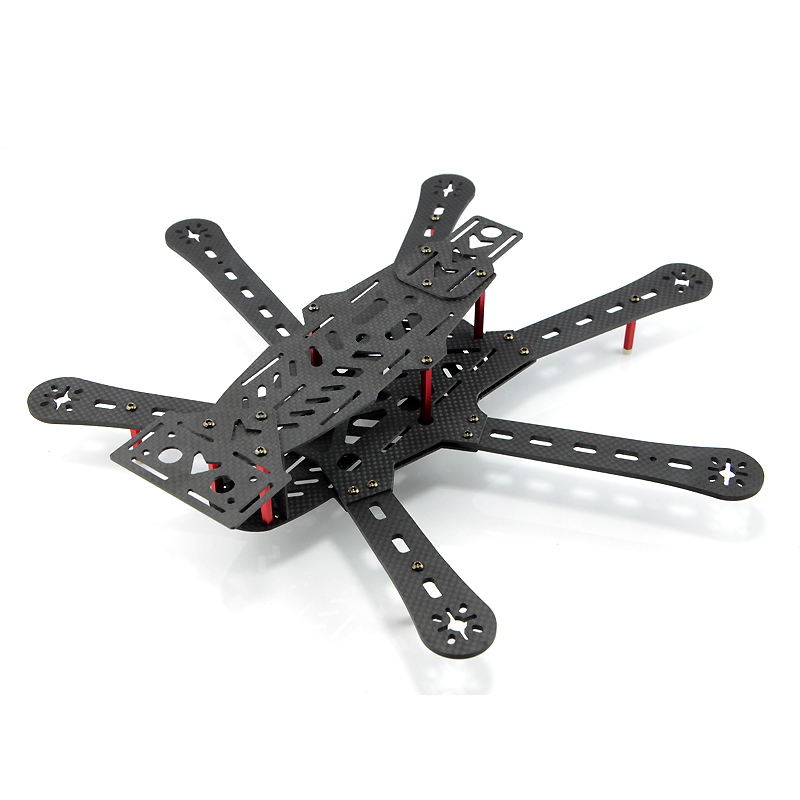
The SPIDER Automation Mini 290 6-Axis FPV Racing Hexacopter Frame is a compact multirotor airframe designed for six-motor UAV configurations, FPV racing systems and custom aerial platforms. Its structure uses 3K twill-weave carbon fibre, a composite material valued in lightweight airframe engineering for its stiffness-to-weight characteristics. The frame features 3mm-thick carbon-fibre arms and anodised aluminium alloy spacers to form the primary structural assembly.
With a stated 290mm wheelbase, the frame provides a six-arm motor arrangement around a central electronics and mounting area. Multiple motor mounting holes on the arms allow installation of compatible brushless motors with matching mounting patterns. The central structure can accommodate suitable flight-control electronics, power-distribution hardware, battery and FPV equipment according to the available mounting space and final build configuration.
The frame is intended for compact propulsion configurations using suggested 1806–2204-class brushless motors, 15A–25A ESCs and 5-inch propellers. These components are recommendations rather than included accessories. Motor selection, propeller clearance, battery capacity and ESC ratings must be evaluated together against the intended aircraft weight and operating requirements.
Carbon-Fibre Construction & Structural Design
The frame uses 3K twill-weave carbon fibre for its structural components. Carbon-fibre composites are commonly used in multirotor airframes because their stiffness-to-weight characteristics support lightweight structural designs. The Mini 290’s arms are specified at 3mm thickness and form the mounting structure for the six propulsion units.
- 3K Twill-Weave Carbon Fibre: Provides the composite construction used for the frame structure and arms.
- 3mm Arm Thickness: Provides the stated arm thickness for motor-support and airframe assembly planning.
- Six-Arm Structure: Arranges six motor mounting positions around the central frame for hexacopter configurations.
- Anodised Aluminium Alloy Spacers: Maintain structural separation between frame components and support the assembled layout.
- Multiple Motor Mounting Positions: The arms feature multiple mounting holes for compatible motor mounting patterns.
290mm Hexacopter Configuration
The Mini 290 uses a six-arm configuration with a stated 290mm wheelbase. Compared with a four-motor layout, a hexacopter distributes propulsion across six motor and ESC assemblies. This provides additional propulsion units and allows the aircraft designer to configure motor redundancy, but actual flight capability following a motor or ESC failure depends on the flight controller, control allocation, remaining propulsion capacity, aircraft weight and failure conditions.
- Six-Motor Propulsion Layout: Supports six brushless motor and ESC assemblies for a hexacopter configuration.
- Compact Airframe Geometry: The 290mm wheelbase provides a defined motor-layout size for compact multirotor builds.
- Motor Position Flexibility: Multiple mounting holes support compatible motor mounting arrangements.
- Central Component Space: Provides an area for installing flight-control and power-system electronics, subject to component dimensions.
Motor, ESC & Propeller Configuration
The frame is suggested for compact brushless propulsion systems. The following component classes can be considered during build planning, but final compatibility must be checked against the motor mounting pattern, propeller diameter, arm spacing, ESC electrical ratings and battery voltage.
- Suggested Motor Class: 1806 to 2204 brushless DC motors.
- Suggested ESC Rating: 15A–25A ESCs, selected according to the actual motor and propeller current requirements.
- Suggested Propeller Size: 5-inch propellers, with clockwise and counter-clockwise rotation variants as required by the flight-control configuration.
- Motor Mounting: Confirm motor-hole spacing, screw dimensions and arm clearance before selecting motors.
- Propeller Clearance: Check the complete six-propeller layout for adequate clearance between adjacent propellers, arms and frame components.
Electronics & Battery Integration
The central frame area is intended for integration of the flight controller, power-distribution hardware, battery and FPV electronics. Component placement should account for wiring access, cooling, vibration, centre of gravity and the physical clearance required by the six-arm propulsion layout.
- Flight Controller: Install a compatible flight controller with suitable mounting support and sufficient clearance for its connectors and wiring.
- Power Distribution Board: Use a suitable power-distribution arrangement to distribute battery power to the six ESCs.
- Battery Integration: The suggested battery class is 3S LiPo with 1500–2200mAh capacity. Confirm compatibility with the selected motors and ESCs before use.
- FPV Camera: The frame can accommodate compatible FPV camera equipment where mounting space and viewing orientation permit.
- Wiring Layout: Route propulsion and signal wiring to avoid interference with propellers, moving components and sensitive electronics.
Applications
- FPV Racing Hexacopters: Six-motor airframe construction for compact FPV racing platforms.
- Mini Hexacopter Development: Development of compact six-axis multirotor UAV configurations.
- Custom UAV Assembly: Structural platform for custom-built six-motor aerial systems.
- Carbon-Fibre Multirotor Builds: Airframe integration where lightweight composite structural components are preferred.
- FPV Camera Platforms: Installation of compatible onboard FPV camera equipment.
- Flight Controller Integration: Mounting of compatible autopilot and multirotor flight-control electronics.
- Brushless Propulsion Systems: Integration of six compatible brushless motors and ESCs.
- Compact Aerial Robotics: Mechanical platform for experimental and application-specific aerial robotic systems.
- UAV Electronics Prototyping: Development and evaluation of flight-control, power-distribution and FPV electronics arrangements.
- Hexacopter Power-System Development: Assembly and testing of six-motor battery-powered propulsion configurations.
- Custom Camera-Carrying UAVs: Development of compact aerial platforms with appropriately sized camera payloads.
- Multirotor Frame Replacement: Replacement of a compatible Mini 290 hexacopter frame assembly during maintenance or rebuilding.
Package Includes
- 2 × Pure Carbon-Fibre Hexacopter Frame Plates
- 4 × Carbon-Fibre Arms
- 8 × Aluminium Alloy Spacers
- 1 × Set of Screws
Note: Motors, ESCs, propellers, battery, power-distribution board, flight controller, FPV camera and other electronic accessories are not included.
Product Specifications
| Parameter | Specification |
|---|---|
| Product Type | FPV Racing Hexacopter Frame |
| Model | Mini 290 |
| Multirotor Configuration | 6-Axis / Six-Arm Hexacopter |
| Wheelbase | 290mm |
| Frame Material | 3K Twill-Weave Carbon Fibre |
| Arm Material | Carbon Fibre |
| Arm Thickness | 3mm |
| Spacer Material | Anodised Aluminium Alloy |
| Frame Weight | Approximately 180g |
| Motor Mounting | Multiple motor mounting holes on the arms |
| Suggested Motor Class | 1806–2204 Brushless DC Motors |
| Suggested ESC Rating | 15A–25A |
| Suggested Propeller Size | 5-inch |
| Suggested Battery | 3S LiPo, 1500–2200mAh |
| Package Quantity | 2 frame plates, 4 arms, 8 spacers and 1 screw set |
Installation & Operating Recommendations
- Inspect Carbon-Fibre Components: Check the plates and arms for cracks, delamination, chipped edges or other structural damage before assembly.
- Verify Arm Orientation: Arrange all six arms in the intended hexacopter geometry and confirm that the motor mounting positions are correctly aligned.
- Use Compatible Fasteners: Select and install the supplied screws according to the frame’s mounting arrangement. Avoid overtightening, which can damage composite components or threaded interfaces.
- Check Motor Mounting Patterns: Confirm the motor-hole spacing and screw dimensions before fitting the selected brushless motors.
- Maintain Propeller Clearance: Verify that all six propellers can rotate without contacting adjacent propellers, arms, wiring or mounted equipment.
- Match the Propulsion System: Select motors, propellers, ESCs and battery voltage as a complete system using manufacturer electrical and thrust data.
- Check ESC Current Ratings: Ensure each ESC can support the current demanded by its motor and propeller combination under the intended operating conditions.
- Secure the Battery: Position and restrain the battery so that it cannot shift during acceleration, manoeuvres or landing.
- Balance Component Placement: Arrange the flight controller, battery and payload to maintain an appropriate centre of gravity and balanced loading across the frame.
- Protect Carbon-Fibre Edges: Keep exposed conductive carbon-fibre surfaces away from uninsulated electrical connections to prevent accidental short circuits.
- Inspect After Impact: Examine arms, plates, spacers and fasteners following hard landings or collisions before returning the aircraft to service.
- Verify Flight-Control Configuration: Configure the flight controller for the correct six-motor geometry and verify motor order and rotation direction before installing propellers.
- Perform a Controlled Test: Complete a restrained electronics and propulsion check, followed by a cautious initial flight evaluation in an appropriate test area.