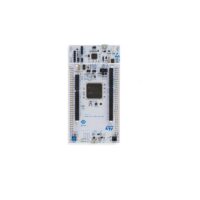


SPIDER Automation STMicroelectronics STM32 Nucleo-144 Development Board | STM32F303ZE Evaluation MCU
Description
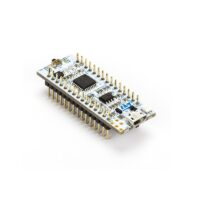
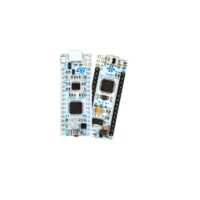
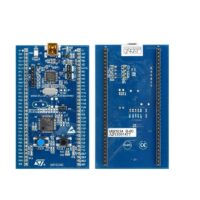
SPIDER Automation STMicroelectronics STM32 Nucleo-144 Development Board provides an affordable, flexible, and robust way for users to test new design concepts and build functional prototypes using powerful STM32 microcontrollers. Equipped with the STM32F303ZE microcontroller in an LQFP144 package, it harnesses a 32-bit ARM Cortex-M4 RISC core complete with a hardware floating-point unit (FPU), digital signal processing (DSP) instructions, and high-speed memory arrays.
The Nucleo-144 platform stands out for its extensive expandability. It features the ST Zio connector—an advanced extension of the standard Arduino Uno V3 layout—which exposes a wide range of additional peripheral signals. Furthermore, ST morpho extension pin headers provide full, unhindered access to all microcontroller I/Os, allowing effortless stacking of specialized shields. Completely self-contained with an integrated ST-LINK/V2-1 debugger/programmer, Ethernet interface, USB OTG support, and direct access to ARM mbed online resources, it delivers a turnkey workstation for professional embedded development.
Key Features
- STM32F303ZE Microcontroller: 32-bit ARM Cortex-M4 core with FPU and DSP instructions, housed in a 144-pin LQFP package delivering high real-time control efficiency.
- ST Zio Connector Interface: Expands Arduino™ Uno V3 connectivity (pins A0 to A5, D0 to D15) with extra signal lines exposing a comprehensive array of peripherals.
- ST Morpho Extension Headers: Dedicated pin header footprints providing full breakout access to every single STM32 input/output pin for custom wire configurations.
- ARM® mbed Enabled™ Support: Seamless integration with online development resources and toolchains via mbed.org.
- On-Board ST-LINK/V2-1 Debugger/Programmer: Integrated debugging circuit with an SWD connector and a selection-mode switch enabling standalone use as an external probe.
- USB Re-Enumeration Capability: Supports three distinct interfaces over USB: Virtual COM port, mass storage drive, and direct debug port.
- Flexible Power Supply Options: Powered via 5V from ST-LINK VBUS, external 3.3V / 7–12V sources on ST Zio or morpho connectors, or 5V on the ST morpho header.
- USB OTG & Ethernet Networking: Outfitted with a Micro-AB connector for USB OTG/full-speed device operation and an IEEE-802.3-2002 compliant Ethernet port.
- Interactive Controls & Clocking: Features three user LEDs, two push-buttons (USER and RESET), and a precise 32.768 kHz crystal oscillator for real-time clock functions.
- Comprehensive Software HAL Library: Backed by free, extensive software packages containing example drivers and startup code.
- Broad IDE Compatibility: Fully supports major professional and open-source development environments including IAR™, Keil®, and GCC-based toolchains.
Benefits
- Zero External Probe Requirement: Onboard ST-LINK/V2-1 eliminates the need to purchase expensive standalone debuggers for flashing and testing.
- Unrivaled Hardware Scalability: Dual expansion layouts (ST Zio + ST morpho) allow you to easily stack commercial shields or wire up custom sensor arrays.
- Versatile Networking & USB Power: Built-in Ethernet and USB OTG capabilities enable immediate prototyping of connected IoT edge devices and communication gateways.
- Accelerated Development Cycle: Rich software HAL examples and multi-IDE support streamline code development, debugging, and migration.
Applications
- Industrial Automation & Motor Control: Precision feedback controllers, inverter drives, and factory automation sub-nodes leveraging STM32F3 analog peripherals.
- IoT Connected Gateways & Data Loggers: Networked telemetry units utilizing onboard Ethernet and USB communication protocols.
- Smart Home & Building Automation: Centralized sensor aggregators, environmental monitoring hubs, and lighting control systems.
- Embedded Systems Education & R&D Labs: University engineering courses teaching 32-bit ARM Cortex-M4 architecture, bare-metal programming, and RTOS development.
- General-Purpose Microcontroller Prototyping: Rapid verification of digital control logic, timer functions, and peripheral interfacing.
Package Includes
- 1 x STM32 Nucleo-144 Development Board (STM32F303ZE MCU with On-Board Debugger, Arduino, ST Zio & Morpho Compatibility)
Technical Specifications
| Parameter | Specification |
|---|---|
| Brand / Series | SPIDER Automation / STMicroelectronics STM32 Nucleo-144 Series |
| Item Type | ARM Microcontroller Development Board with On-Board Debugger (Kit) |
| Model Order Code / Number | Nucleo-144 / STM32F303ZE |
| Microcontroller Silicon | STM32F303ZE (LQFP144 Package) |
| Core Architecture / Bits | 32-bit ARM Cortex-M4 RISC Processor Core with FPU & DSP |
| Embedded Debugger | On-Board ST-LINK/V2-1 with SWD Connector & Standalone Mode Switch |
| Expansion Connectors | ST Zio Connector (Arduino Uno V3 Compatible) & ST Morpho Extension Headers |
| Networking & USB Ports | IEEE-802.3-2002 Compliant Ethernet Port & USB OTG/Full-Speed Micro-AB Port |
| Oscillator & Indicators | 32.768 kHz Crystal Oscillator, 3 User LEDs, & 2 Push-Buttons (USER / RESET) |
| Power Supply Options | 5V (USB VBUS), 3.3V / 7–12V (External on ST Zio/Morpho), or 5V (ST Morpho) |
| Software & IDE Ecosystem | STM32 HAL Library, mbed Enabled, IAR™, Keil®, & GCC-based IDEs |
| Package Shipping Weight | 0.1 kg (100 g) |
| Package Shipping Dimensions | 19 cm × 10 cm × 4 cm |